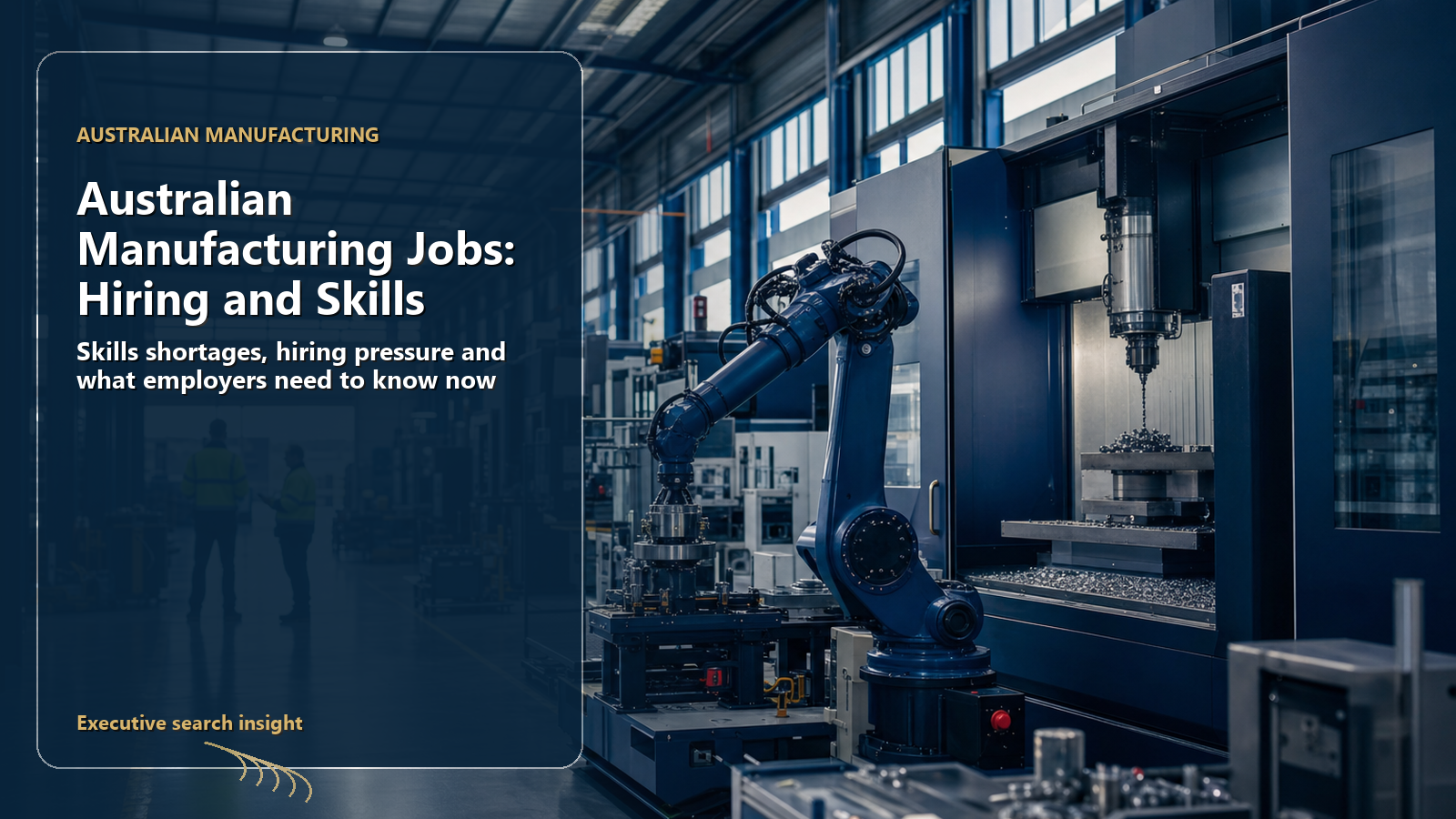
Australian manufacturing is no longer a nostalgia story. Policy, defence, clean energy, medical technology and advanced production are pushing the sector back into boardroom and budget conversations. The harder question for employers is not whether manufacturing matters again. It is whether they can hire, train and retain the people needed to make the investment case real.
For HR directors, operations leaders, plant managers and CFOs, the hiring picture is mixed. Output and profits have recovered in parts of the sector, yet official employment has been soft in the near term while vacancies in manufacturing remain elevated. Big consulting firms, the Australian Industry Group and government skills bodies all point in the same direction: the sector needs more digital, technical and leadership capability, and the current pipeline is not keeping pace.
Manufacturing is doing more again, but not everywhere
The narrative has shifted. Federal policy under Future Made in Australia, the National Reconstruction Fund and defence and clean-energy supply chain programs is designed to lift sovereign capability. The Manufacturing Industry Skills Alliance says manufacturing will contribute more than $100 billion to the Australian economy in 2025 and employ nearly one million people across diverse sub-sectors. Manufacturing Industry Skills Alliance
At the same time, headline employment data tells a more cautious story. Jobs and Skills Australia reports that manufacturing employment fell by 8,700 workers, or about 1 per cent, over the year to February 2026. That follows a long period of structural change in which employment share declined even as parts of the sector became more productive and more specialised. Jobs and Skills Australia
The Australian Industry Group’s Manufacturing in Australia performance benchmark report shows why the mood inside the sector can still feel stronger than the headline job count. In 2023-24, real output growth was 4.1 per cent, gross operating profits grew 9.3 per cent, and manufacturers invested heavily in capex even as employment growth was negative. Labour supply, not demand for product, was described as the most acute pressure. Australian Industry Group
The practical read for hiring managers is that manufacturing is splitting. Food and beverages, metals, defence-related production, medical devices, batteries and advanced components are where growth and investment narratives cluster. Traditional high-volume segments without a technology or sovereign-capability angle face tougher hiring economics.
Vacancies are still high in manufacturing
If employment growth is soft, why do so many employers say they cannot fill roles?
The ABS Job Vacancies survey is instructive. In February 2026, seasonally adjusted vacancies in manufacturing were 18,600. That is below the pandemic peak but well above the long-run average, and manufacturing vacancies rose 3.6 per cent year on year while total vacancies lifted 3.7 per cent. Australian Bureau of Statistics
Ai Group reported that around 19 per cent of manufacturing businesses had job vacancies in early 2024, with about one in five saying vacancies were affecting operations. Its 2025 Australian Industry Outlook found 75 per cent of businesses were affected by workforce shortages in 2024, and 71 per cent expected shortages to continue. Shortages were reported across both higher-skilled and lower-skilled roles. Australian Industry Group
That is not a cyclical blip. It is a structural talent market. Employers are competing for maintenance technicians, production supervisors, quality and continuous-improvement specialists, supply chain leaders, HR business partners who understand shift work, and finance leaders who can model capital projects, inventory and working capital under cost pressure.
What McKinsey and the Big Four say about the workforce shift
McKinsey: skills are changing faster than job titles
McKinsey’s operations research consistently argues that manufacturing and supply chain leaders must treat workforce building as a core value lever, not a HR afterthought. Its work on the manufacturing renaissance notes that automation and digitisation often create new roles rather than simply remove people, but only where employers invest in upskilling and reskilling. McKinsey also highlights that demand is shifting from physical and manual tasks toward technological and cognitive skills. McKinsey & Company
For Australian employers, the global lesson still applies: the constraint is not only headcount. It is capability mix. Plants need people who can work with data, robotics, predictive maintenance, quality systems and cross-functional problem solving. McKinsey’s manufacturing and supply chain practice also stresses recruiting and inspiring Gen Z workers, who remain open to manufacturing careers when employers explain pathways, technology and purpose clearly. McKinsey & Company
PwC: AI adoption is uneven on the shop floor
PwC Australia’s Global Workforce Hopes and Fears Survey 2025 shows Australian workers are optimistic about AI, but daily use remains limited, especially outside office roles. Only 10 per cent of Australian workers reported daily generative AI use, versus 14 per cent globally, and usage was far lower among manual workers than office employees. PwC Australia
For manufacturing leaders, that gap matters. Finance and HR may be experimenting with AI in reporting, workforce planning or recruitment workflows, while production teams still need practical tools, training time and supervisors who can coach new ways of working. PwC’s message to employers is to close the adoption gap before assuming AI will solve skills shortages on its own.
KPMG: Industry 4.0 is the hiring and training agenda
KPMG Australia frames Industry 4.0 as the pathway for manufacturers to build sovereign capability, reduce cost and innovate. Its Australian manufacturing insights emphasise smart robotics, sensors, data analytics, additive manufacturing and workforce alignment. KPMG modelling commissioned by CSIRO also linked circular-economy and Industry 4.0 adoption to substantial job potential when firms invest in engineering, data science and new operating models. KPMG Australia
KPMG’s intelligent manufacturing framework is useful for hiring discussions because it separates three phases: enabling people and foundations, embedding AI into workflows, and evolving models across ecosystems. Employers hiring today should ask which phase they are in. A plant supervisor hire for 2026 may need change leadership as much as technical supervision.
KPMG’s 2026 Global Tech Report for industrial manufacturing adds another pressure point: a large majority of manufacturing technology leaders expect managing AI agents to become a critical workplace skill within five years, with workforce KPIs and operating models shifting toward human-AI collaboration. KPMG
Deloitte and EY: consulting demand mirrors client pain
Deloitte Australia’s industrial transformation and strategy teams are hiring consultants and senior consultants with experience in defence programs, energy transition, capital assets, procurement, engineering and supply chain resilience. That hiring pattern is a market signal: clients need help with complex program delivery, not just cost cutting. Deloitte Australia
Deloitte’s global manufacturing skills research, often cited with The Manufacturing Institute in the United States, warns that smart manufacturing raises demand for simulation, data science, logistics, software and maintenance technology skills. Australian leaders can use that research directionally even where US vacancy numbers do not map one for one. Deloitte
EY in Australia is actively recruiting supply chain and operations consultants with manufacturing excellence, lean, procurement and digital supply chain experience in Sydney and Melbourne. That mirrors what manufacturers themselves are trying to build internally: cross-functional leaders who can connect operations, technology and commercial outcomes. EY Australia
Australia’s workforce plans: what employers should act on
The Manufacturing Industry Skills Alliance 2025 Workforce Plan, Pathways to Transformation, sets five pillars: clean manufacturing, circular economy, advanced technology, sovereign capability, and a strong skills system. It calls for more apprenticeships, training aligned to industry needs, and better attraction of new talent. Manufacturing Industry Skills Alliance
The earlier 2024 plan noted four persistent challenges: apprentice pipeline, diversity, an ageing workforce, and emerging skills in advanced manufacturing and Industry 4.0. It also highlighted occupations from metal trades and engineering to food production roles where retention and training matter. National Skills Week
Jobs and Skills Australia’s longer-run projections are more positive than near-term headlines. The 2023 annual jobs and skills report projected manufacturing employment to grow from about 881,000 in May 2023 to about 1,025,000 by May 2033, with the sector expected to regain share after a long decline. Employers should use that as a workforce planning horizon, not as proof that hiring is easy today. Jobs and Skills Australia
CSIRO’s Advanced Manufacturing Roadmap remains relevant for hiring strategy because it defines where value will sit: design, R&D, customisation, after-sales services, sensors, automation, advanced materials and digital literacy across the workforce. CSIRO
Who is hiring, and for what roles?
Manufacturing hiring in 2026 is not one market. Patterns we see across industry research and employer behaviour include:
Production and maintenance: fitters, electricians, maintenance planners, reliability engineers and supervisors who can reduce downtime.
Quality and continuous improvement: lean, six sigma, ISO and operational excellence leads who can stabilise processes while plants digitise.
Engineering and technology: robotics, automation, controls, process engineering, manufacturing engineering and OT/IT convergence roles.
Supply chain and procurement: strategic sourcing, planning, logistics and resilience roles linked to sovereign capability and nearshoring.
HR and workforce: employee relations aware HR business partners, workforce planners, L&D leads and safety professionals who can support shift-based workforces.
Finance and commercial: management accountants, financial controllers and CFOs who understand inventory, capex, project economics, grants and margin pressure in manufacturing.
UKG’s 2025 ANZ manufacturing research reported that 79 per cent of Australian manufacturers found it difficult to find or train skilled tradespeople, and more than 60 per cent had hired people with no prior industry experience in the past year to fill essential roles. Flexibility ranked alongside pay for many frontline employees. UKG
What candidates want now
Manufacturing employers are competing with sectors that offer clearer remote-work narratives and faster perceived career progression. Candidates are more selective. They ask about training, safety culture, shift flexibility, technology exposure and whether the work has a visible purpose, such as clean energy, health, defence or local supply security.
McKinsey operations research suggests Gen Z remains interested in manufacturing when career paths and modern tools are explained clearly. Younger candidates prioritise learning, development and meaningful work, and respond when employers offer progression, mentorship and practical flexibility within shift constraints. McKinsey & Company
For employers, the implication is that employer brand and hiring process matter as much as pay bands. A slow, opaque recruitment process will lose capable technicians and supervisors to competitors who move faster and show a credible development path.
What finance and HR leaders should do differently
Treat workforce as a capital allocation decision. If Industry 4.0 capex is in the budget, training and targeted hiring should be attached to the same business case. KPMG and McKinsey both frame workforce building as part of operational value creation, not a separate HR cost line.
Hire for adjacent skills, then train. With vacancy rates high, waiting for the perfect résumé is expensive. Structured onboarding, mentorship and micro-credentials can widen the funnel, consistent with MISA’s skills-system emphasis.
Segment the EVP by site and role. Flexibility means different things on a production line versus in a shared services finance team. Clarity on shifts, overtime, leave and upskilling beats generic culture language.
Upgrade workforce data. PwC’s AI adoption gap suggests many plants lack baseline visibility on skills by team. Simple skills inventories help prioritise hiring and training.
Use executive search selectively for pivotal roles. Plant managers, operations directors, CFOs and HR leaders who must lead transformation are high-leverage hires. A boutique search partner with real manufacturing and finance networks can often move faster and assess fit more deeply than a generic national process, especially in mid-market and owner-led manufacturers.
Hiring manufacturing leaders or finance talent?
Byron Thomas Recruitment supports executive search and senior finance hiring for manufacturers, industrials and growth businesses across Sydney, Australia and New Zealand. We help employers define the brief, test the market and reach leaders who understand operations, capital discipline and practical execution.
Talk to Byron Thomas Recruitment about executive searchPractical takeaways
For boards and CEOs: manufacturing strategy fails without a credible workforce plan tied to technology and capex.
For operations leaders: the bottleneck is often capability mix, not just headcount.
For HR: speed, clarity and development pathways are competitive weapons in manufacturing hiring.
For CFOs: model hiring, training and automation as one investment story, not three unrelated budgets.
For candidates: manufacturing roles increasingly reward digital literacy, safety leadership and cross-functional communication, not only trade or technical depth.
Sources
- Jobs and Skills Australia: Manufacturing industry profile
- Jobs and Skills Australia: Employment projections
- Australian Bureau of Statistics: Job Vacancies, Australia, February 2026
- Australian Industry Group: Manufacturing in Australia performance benchmark report 2024
- Australian Industry Group: Australian Industry Outlook for 2025
- Manufacturing Industry Skills Alliance: 2025 Workforce Plan launch
- National Skills Week: 2024 Manufacturing Workforce Plan media release
- CSIRO: Advanced Manufacturing Roadmap
- McKinsey & Company: Delivering the US manufacturing renaissance
- McKinsey & Company: Manufacturing and supply chain
- PwC Australia: Global Workforce Hopes and Fears Survey 2025
- KPMG Australia: The Industry 4.0 advantage in industrial manufacturing
- KPMG: Global Tech Report 2026, Industrial Manufacturing
- Deloitte Australia: Industrial Transformation roles
- Deloitte: 2025 Manufacturing Industry Outlook
- EY Australia: Senior Consultant, Supply Chain and Operations
- UKG: Australia’s manufacturing revival depends on workforce reinvention